What is speed climbing?
Speed climbing is sprinting, vertically: a head-to-head race up a 15-meter wall on a single, standardized route that is identical everywhere in the world. Two climbers, two lanes, one clock. First to slap the buzzer at the top wins. It's the fastest sport in the Olympics, with the men's world record at 4.54 seconds and the women's at 5.99, and the top form of competition is the World Climbing Series.
One route. 20 hand holds. Memorized by every climber on earth.
What makes speed climbing unique among climbing disciplines is its standardization. In lead and bouldering, every route and problem is different. In speed, the route (designed by route-setter Jacky Godoffe) has been frozen since 2007: the same hand and foot holds, in the same positions, on every internationally certified wall on the planet. That turns speed into a pure performance sport. It's you against the clock, and the clock never changes.
Timing is electronic and unforgiving: a pressure pad at the base starts the clock and a touchpad at the top stops it, accurate to the thousandth of a second. The wall uses an auto belay, so climbers never need a partner to hold the rope. A fixed route plus a self-braking belay is what makes speed the easiest discipline to start learning on your own.
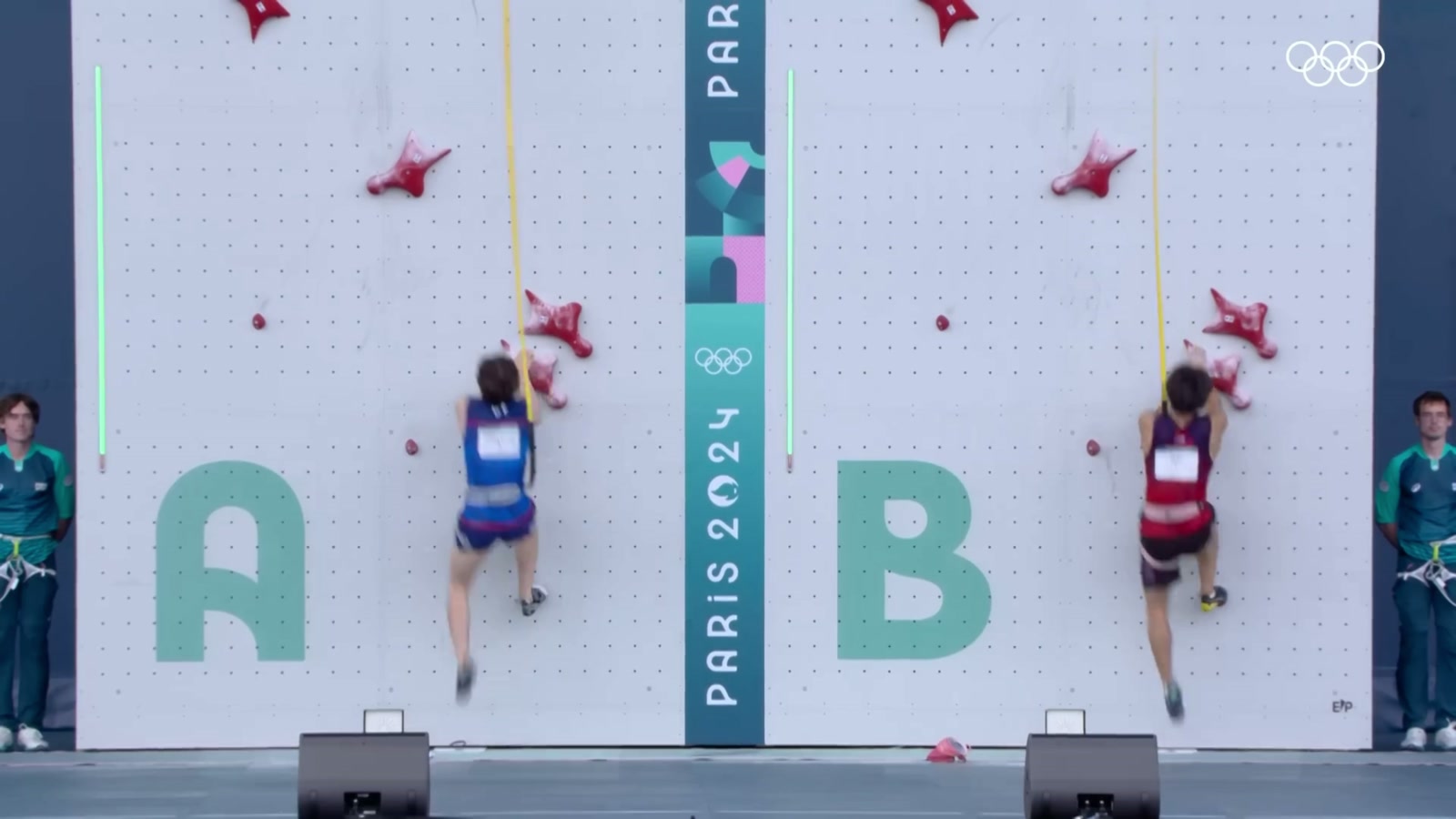
How a race actually works.
Simple to watch, brutal in the details. The margins are tiny: elite finals are often decided by less than a tenth of a second, so a clean run and a fast reaction off the pad can matter more than raw power.
From a niche race to an Olympic medal event.
The debut
Sport climbing entered the Olympics as one combined event: Boulder, Lead, and Speed scores multiplied together to crown a single winner, mostly because new sports get very few medals. The format merged several different sports into one, and highly specialized speed climbers had no real way to compete.
Speed gets its own medal
Paris granted Speed a standalone medal and combined the far more similar Boulder and Lead. Veddriq Leonardo and Aleksandra Mirosław took the first golds; Sam Watson took bronze and broke the world record. The sport exploded: records, registrations, viewership, and new standard walls around the world.
Three separate events
At the Los Angeles 2028 Games, Boulder, Lead, and Speed each get their own event. Speed returns to the top stage with the field faster than it has ever been.
Honestly, anyone can speed climb.
A little climbing experience helps: if you can boulder or lead around the V3 level, you've got everything you need to start. From there, here's the pathway to getting fast.
Start with the intro guide
Our free intro guide on Skool covers pretty much everything you need to know about getting started.
Find a wall
Browse our global directory of speed walls mapped across the world. None near you? No problem, you can train without a wall until you reach one.
Join the community
Hosted on Skool and built to be accessible to everyone: you can go from total beginner to established speed climber completely free. There are paid options for advanced training and serious athletes, but you can learn, train, and get better without ever touching them.
Train and start enjoying it
Speed climbing has an amazing community and a sense of progression, competition, and excitement unlike most other sports. Once you start lowering your times, it's hard to stop.