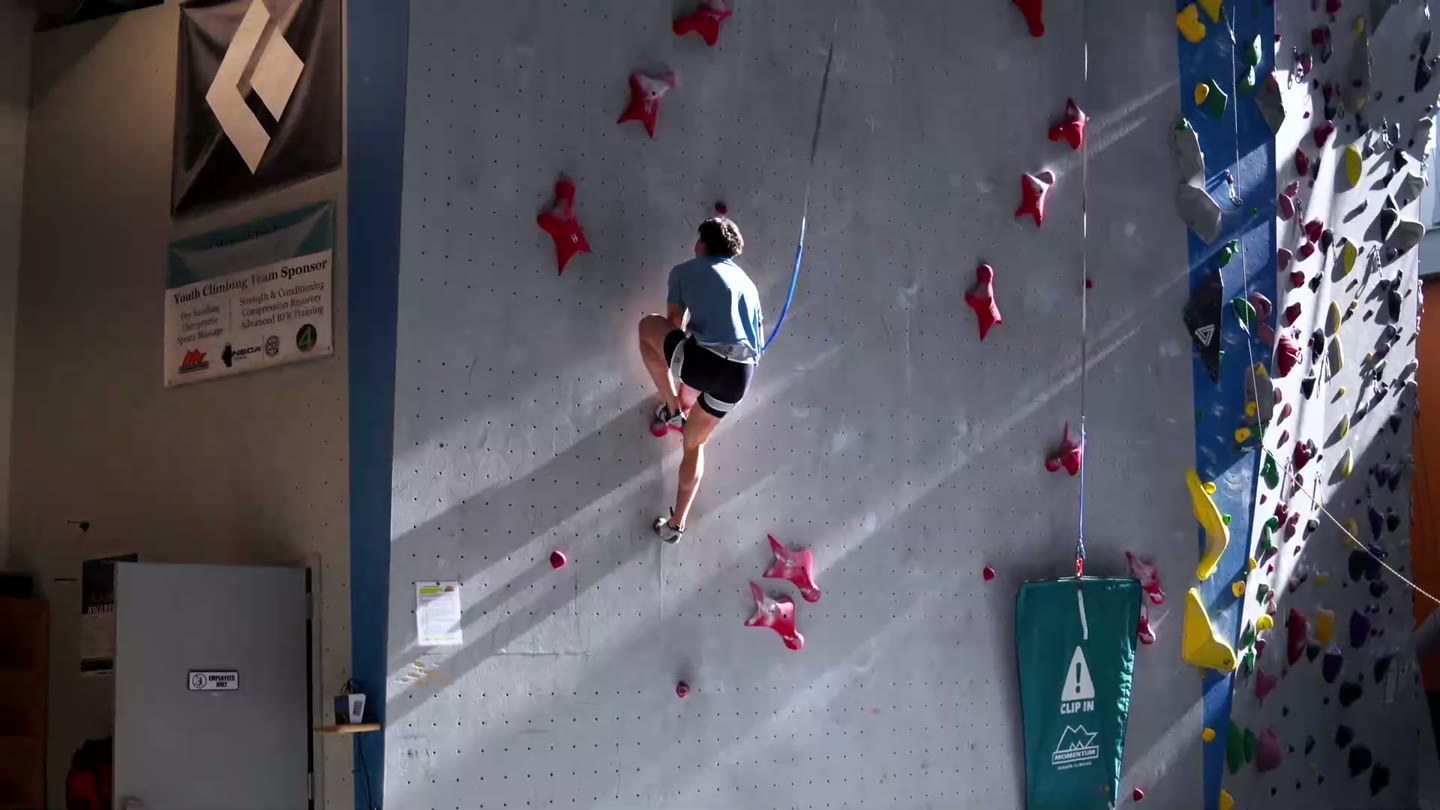
Watch a men's final in 2026 and you'll see nearly every athlete leave the ground and, a few moves later, launch past a hold they never touch. That single skipped grip is the most copied move in the sport. It has a name, an inventor, and a growing pile of broken records behind it. This is the Tomoa skip.
What is the Tomoa skip?
The Tomoa skip is a piece of speed climbing beta in which a climber bypasses one of the lower hand holds entirely, replacing a series of controlled grabs with a single dynamic, coordinated move. Instead of matching hands up the wall grip by grip, the climber uses a foot on the hold their hand just left and drives upward in one explosive motion, catching a higher hold and skipping the one in between.
The point is efficiency. The standardized speed route is a fixed 15-meter wall on a 5-degree overhang, with 20 hand holds and 11 foot holds that haven't changed since route-setter Jacky Godoffe locked them in place in 2007. Because the layout never moves, every athlete climbs the exact same puzzle. That turns speed climbing into a memorized sequence, and it means any move that shaves distance off the line is worth chasing. Skipping a hold turns a small zig-zag into something closer to a straight line, and the shortest path up the wall is the fastest one.
Why "skip" and not just "faster"?
It helps to separate two things. Climbing the standard sequence quickly is about power and precision on known holds. The skip is different: it removes a hold from the sequence altogether. You're not doing the same moves faster; you're doing fewer, bigger moves. That's why it took a specific kind of athlete to see it in the first place.
Who invented the Tomoa skip?
The move is named after Tomoa Narasaki, the Japanese climber who popularized it. Narasaki isn't a speed specialist by trade. He's an all-rounder and a world-class boulderer, and that background is exactly why the skip exists. Boulderers live on powerful, dynamic, full-body movement, so when Narasaki looked at the standard speed beta around 2018, he saw a lower hold as wasted motion rather than a fixed step. He brought a bouldering brain to a memorized sprint and rewrote part of the sequence.
That crossover is the whole story. The speed route had been climbed more or less the same way for years. It took someone fluent in the explosive style of another discipline to notice that a coordinated dyno could replace a tidy hand match, and that the time saved was real.
Narasaki wasn't the only climber experimenting with skips, either. Back in 2018, Iran's Reza Alipour famously skipped the fourth hand hold, showing the elite field was already probing the route for shortcuts. But it's Narasaki's version that stuck as standard beta and carries his name.
Why did it spread through the elite field?
Simple: it works, and everyone can see it working. Speed climbing is unusually transparent. There's one wall, one sequence, and a clock, so when a technique helps the fastest athletes go faster, rivals copy it almost immediately or get left behind.
Look at where the records sit now. The men's world record is 4.54 seconds, set by China's Zhao Yicheng赵一程Zhào Yīchéng in 2026, down from Sam Watson's 4.64 in 2025. On the women's side, American Emma Hunt broke the six-second barrier for the first time in history with a 5.99 in 2026. The skip isn't the only reason times keep tumbling, but it's woven into the beta that produced all of them. At the very top, climbing without it simply isn't competitive anymore. What started as one boulderer's insight is now baseline knowledge for anyone chasing a podium.
A quick caution on the numbers: it's tempting to assign an exact time saving to a single move, but the honest answer is that it depends on the athlete, and the gains show up across the whole run rather than at one clean instant. Treat "it makes you faster" as the takeaway, not a stopwatch figure per move.
---
Want the move broken down frame by frame? Inside the Skool community we post detailed beta breakdowns and review members' run footage so you can see exactly where the skip fits your sequence. Join us here.
---
Should beginners try the Tomoa skip?
Short answer: not yet. The Tomoa skip is an advanced move, and rushing to it is one of the most common mistakes newer speed climbers make.
Here's the problem. The skip is a high-commitment dynamic move layered on top of a sequence you're supposed to already know cold. If your standard beta is shaky, adding a big dyno doesn't make you faster, it makes you inconsistent, and inconsistency costs more time than any single hold ever saves. You also risk missed catches and falls that dent your confidence.
The right order looks like this:
- Learn and memorize the standard sequence for all 20 hand holds and 11 foot holds until it's automatic.
- Build clean, repeatable runs where your footwork and hand order never vary.
- Only then start layering in advanced beta like the skip, one section at a time.
The good news is the route is graded around F6b, so the individual moves are accessible. Speed comes from repetition and refinement, not from copying the hardest-looking move you saw on a livestream. If you want a structured path through that progression, our guide to the speed route walks through how to build the sequence before you add flourishes.
How does the skip fit the rest of the route?
Coaches usually split the 15-meter wall into three sections: the start, the middle, and the finish. Thinking in sections keeps the run manageable instead of treating it as one blurred sprint.
- The start is about an explosive, clean launch off the ground and finding your rhythm on the lower holds.
- The middle is where efficiency lives, and it's the zone where the Tomoa skip typically does its work, straightening the line and carrying momentum upward.
- The finish is the top-out and the buzzer, where you're converting all that built speed into a clean slap of the timing pad.
Slotting the skip into the middle section is what separates fluent runs from stuttery ones. It only pays off when the sections around it are solid, which loops right back to the point about mastering the basics first. If you want to see how every hold connects, we map out the full beta hold by hold, and you can see where these techniques have driven the world records.
The takeaway
The Tomoa skip is proof that speed climbing is still evolving. One boulderer, Tomoa Narasaki, looked at a route everyone thought was solved, replaced a hand hold with a dynamic move, and helped pull the whole elite field to new records. It's brilliant, it's efficient, and it's advanced, which means the best thing a developing climber can do is respect the order: standard sequence first, dynamic beta later.
Ready to actually put it into your run? Join the speed climbing community on Skool for hold-by-hold beta breakdowns, personal run reviews, and a group of climbers chasing the same clock you are. Come skip your first hold with people who'll help you land it.
Getting into speed climbing? Learn with climbers chasing the same clock.
Join the Community →