2026 has been a demolition year for the record books. Within a span of a few months, the men's mark fell twice, a 17-year-old rewrote what a teenager can do on the wall, and, on a single afternoon in Kraków, a woman broke six seconds for the first time in history while a mixed relay team set a world record that had never existed before. If you blinked in the first half of 2026, you missed a record. Maybe two.
Here's the full story of the speed climbing world record: where it started, how it got standardized, and how humans dragged it down toward numbers that once sounded impossible.
Why the record even makes sense: one wall, everywhere
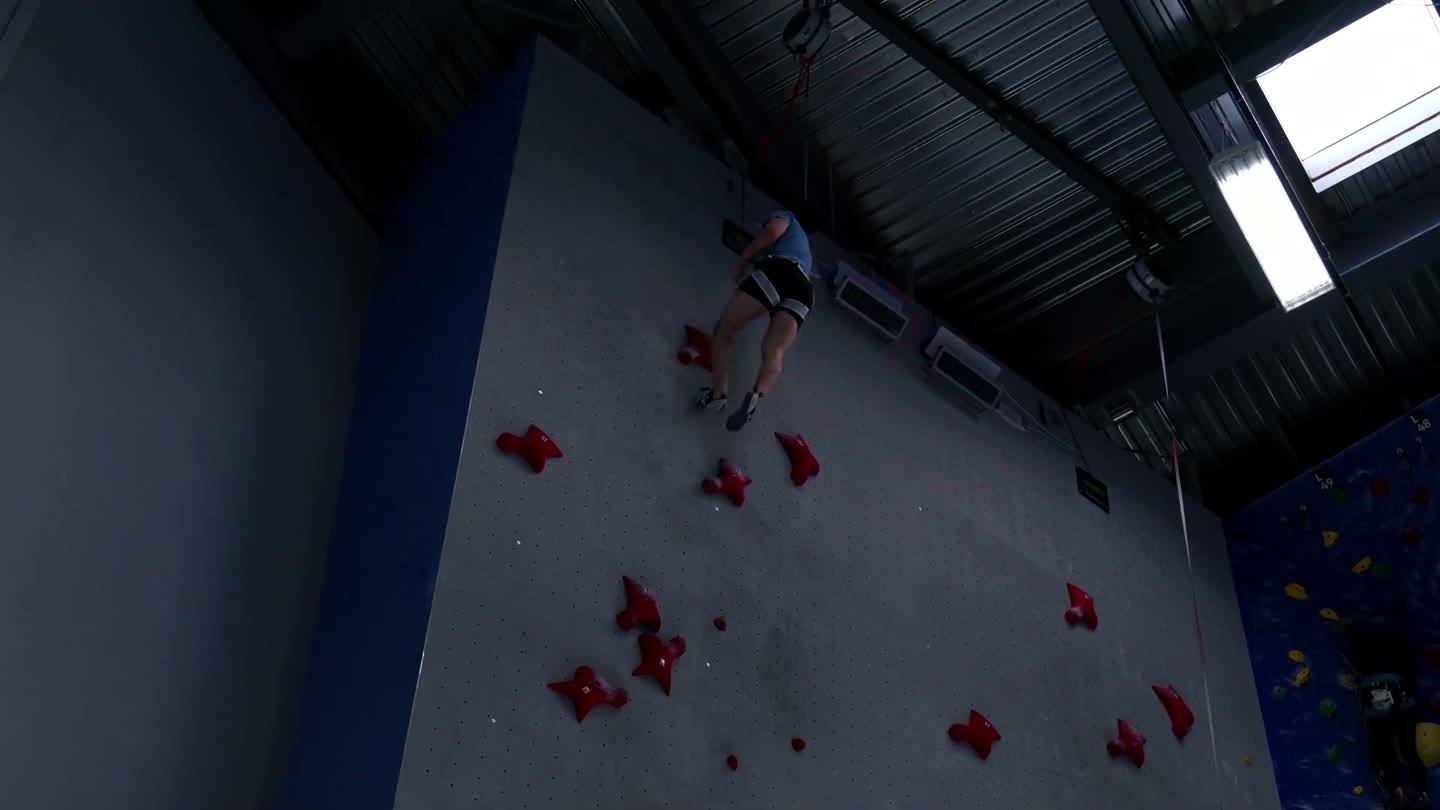
You can't compare 100-meter sprint times if every track is a different length. Speed climbing solves this the same way. In 2007, the route was standardized: 15 meters tall, overhanging five degrees, with the exact same 20 hand holds and 11 foot holds bolted in the exact same positions on every certified wall on Earth.
That's the quiet hero of this whole story. Because the route in Wujiang is identical to the one in Kraków is identical to the one in Salt Lake City, a time set anywhere is directly comparable to a time set anywhere else. Every record below sits on the same 15 meters of standardized wall. If you're new to the discipline, here's what speed climbing is in plain terms.
What is the current speed climbing world record?
As of July 2026, here are the marks that matter:
| Category | World Record | Athlete | Where / When |
|---|---|---|---|
| Men's 15m | 4.54s | Zhao Yicheng赵一程Zhào Yīchéng (China) | Wujiang, May 10 2026 |
| Women's 15m | 5.99s | Emma Hunt (USA) | Kraków, July 4 2026 |
| Mixed Relay | 10.89s | USA (Emma Hunt & Sam Watson) | Kraków, July 4 2026 |
Three records, and two of them are less than a week old at the time of writing. That pace is not normal historically, and it tells you everything about how fast this sport is evolving right now. You can follow live marks on our events and scoreboards page.
Who holds the men's world record?
The men's speed climbing world record belongs to Zhao Yicheng of China at 4.54 seconds, set May 10, 2026 at the World Climbing Series stop in Wujiang. What makes it remarkable isn't just the number, it's the climber. Zhao turned 17 in June 2026, which makes him one of the youngest athletes ever to hold the outright world record.
And 4.54 wasn't his first strike. Zhao had already lowered the record to 4.58 in Sanya on April 28, 2026, before knocking off another few hundredths less than two weeks later. Two world records inside a fortnight from a teenager is the kind of run this sport hasn't seen before.
To appreciate how compressed the modern era is, look at who he took the record from. American Sam Watson had pushed the mark to 4.64 in Bali in 2025, and before that held 4.74. Rewind a little further and you land in the roughly 4.90 era, defined by climbers like Indonesia's Veddriq Leonardo and Indonesia's Kiromal Katibin, who traded the record back and forth as the men's field first cracked deep into the fours.
So in the space of a few years the men's record went from around 4.90 to 4.54. That's an enormous drop in a sport measured in hundredths of a second.
How has the men's record dropped over time?
The trajectory looks something like this:
- ~4.90 era, Leonardo, Katibin and their generation break new ground in the deep fours.
- 4.74 → 4.64, Sam Watson lowers the American and world marks (Bali, 2025).
- 4.58, Zhao Yicheng (Sanya, April 28 2026).
- 4.54, Zhao Yicheng (Wujiang, May 10 2026), the current record.
Every one of those steps is a story of milliseconds, but stack them up and the fastest speed climber on the planet is now well over a third of a second quicker than the record-holders of just a few years ago.
Want to see exactly where those milliseconds are won and lost on the wall? Our breakdown of the beta walks through the movement, hold by hold.
---
Chasing your own personal record? The fastest way to improve is to train the standardized route with people who know it cold. Join climbers dissecting beta, splits, and mistakes every day inside our free community: join us on Skool.
---
Who holds the women's world record?
This is the headline of 2026. The women's speed climbing world record belongs to Emma Hunt of the USA at 5.99 seconds, set July 4, 2026 in Kraków, making her the first woman in history to break six seconds on the standardized route.
Sub-6 for women had been the barrier everyone circled, the same way sub-4-minute was for the mile. For years it sat just out of reach. Poland's Aleksandra Mirosław, the Paris 2024 Olympic champion, owned the women's record and had dragged it down to 6.03 at the 2025 World Championships in Seoul, after holding roughly 6.06 before that. She was the wall the rest of the field kept running into.
Hunt's 5.99 finally punched through it. It's one of those numbers that reframes the whole discipline: the question is no longer if women go sub-6, but how far into the fives they can push. Fittingly, Mirosław, one of the most dominant speed climbers ever, is set to retire at the end of 2026, so the record changing hands in this window feels like a genuine passing of the torch.
What is the mixed relay world record?
July 4, 2026 in Kraków gave us a third piece of history: the first-ever mixed relay world record, set by the USA team of Emma Hunt and Sam Watson at 10.89 seconds.
The mixed relay pairs one man and one woman, and because it's newer as a headline format, its record book is essentially starting fresh. That 10.89 is the benchmark everyone else now chases. Curious where relays and finals are being run? Check the wall map to find certified speed walls and events near you.
Why do the records keep dropping?
Three forces are compounding at once:
- Better beta. Movement sequences keep getting optimized. The most famous example is the "Tomoa skip," a technique, named for Japan's Tomoa Narasaki, that lets climbers skip a hold and save precious time in a key section of the wall. Innovations like it ripple through the whole field once they're proven.
- Deeper fields. There are simply more elite speed climbers than ever, from more countries. When dozens of athletes are all capable of a record on a good day, someone eventually has that day.
- The four-lane format. Modern events run head-to-head heats that reward all-out aggression. Racing a rival in the next lane pulls faster times out of climbers than the clock alone ever could.
Add professional coaching, video analysis, and a generation like Zhao who grew up training the standardized route from childhood, and you get exactly what 2026 delivered: records falling in clusters.
How fast can humans go? What's next?
Predicting the floor of speed climbing is a good way to be wrong. Not long ago, sub-5 for men and sub-6 for women both sounded like ceilings. Now the men are flirting with 4.5 and a woman has already gone under six.
The next targets are coming into view:
- Men: sub-4.5. Zhao's 4.54 puts it within a few hundredths. On the right night, with the right lane and the right beta, it's a matter of when.
- Women: sub-5.9. With the sub-6 barrier broken, 5.9 and then deeper into the fives is the new frontier.
There's a hard physical limit somewhere, reaction time, grip, and the raw speed a human body can accelerate up 15 meters. Nobody knows exactly where it is. But if 2026 proved anything, it's that we haven't found it yet.
Get inside the sport
Speed climbing's records are falling because its athletes and its knowledge are getting sharper, faster. The best way to keep up, and to get faster yourself, is to be in the room where the beta gets broken down.
That's exactly what our community is for. Climbers of every level share splits, dissect world-record runs frame by frame, and help each other shave off the tenths. It's free to join.
Ready to chase your own record? Join the Speed Climbing community on Skool and start getting faster today.
Getting into speed climbing? Learn with climbers chasing the same clock.
Join the Community →