Watch a speed run and it looks impossible: a blur of hands and feet, a slap on the buzzer, and it's over before you've finished your breath. But here's the secret nobody tells you at the bottom of the wall. Of all the climbing disciplines, speed is the easiest one to start, and figuring out how to get into speed climbing takes far less than you'd think.
Why is speed the easiest climbing discipline to start?
Bouldering and lead climbing throw a new problem at you every single session. The holds move, the grades creep up, and there's always a harder route mocking you from the corner. Speed climbing is different, and that difference is the whole point.
The speed route never changes. It's the same standardized 15-meter wall everywhere on Earth, set at a 5-degree overhang with exactly 20 hand holds and 11 foot holds. It was designed by route-setter Jacky Godoffe and locked in as a global standard back in 2007, which means the wall you train on in your local gym is identical to the one used at the Olympics. Tokyo 2020, Paris 2024, and LA28 all race the same holds you'll be grabbing on day one.
That consistency is a gift for beginners. You're not learning thousands of movements; you're learning one route and getting faster at it. The overall difficulty sits around F6b (5.10c), so it's approachable terrain. The challenge isn't the grade. It's the clock.
Do you need a partner to speed climb?
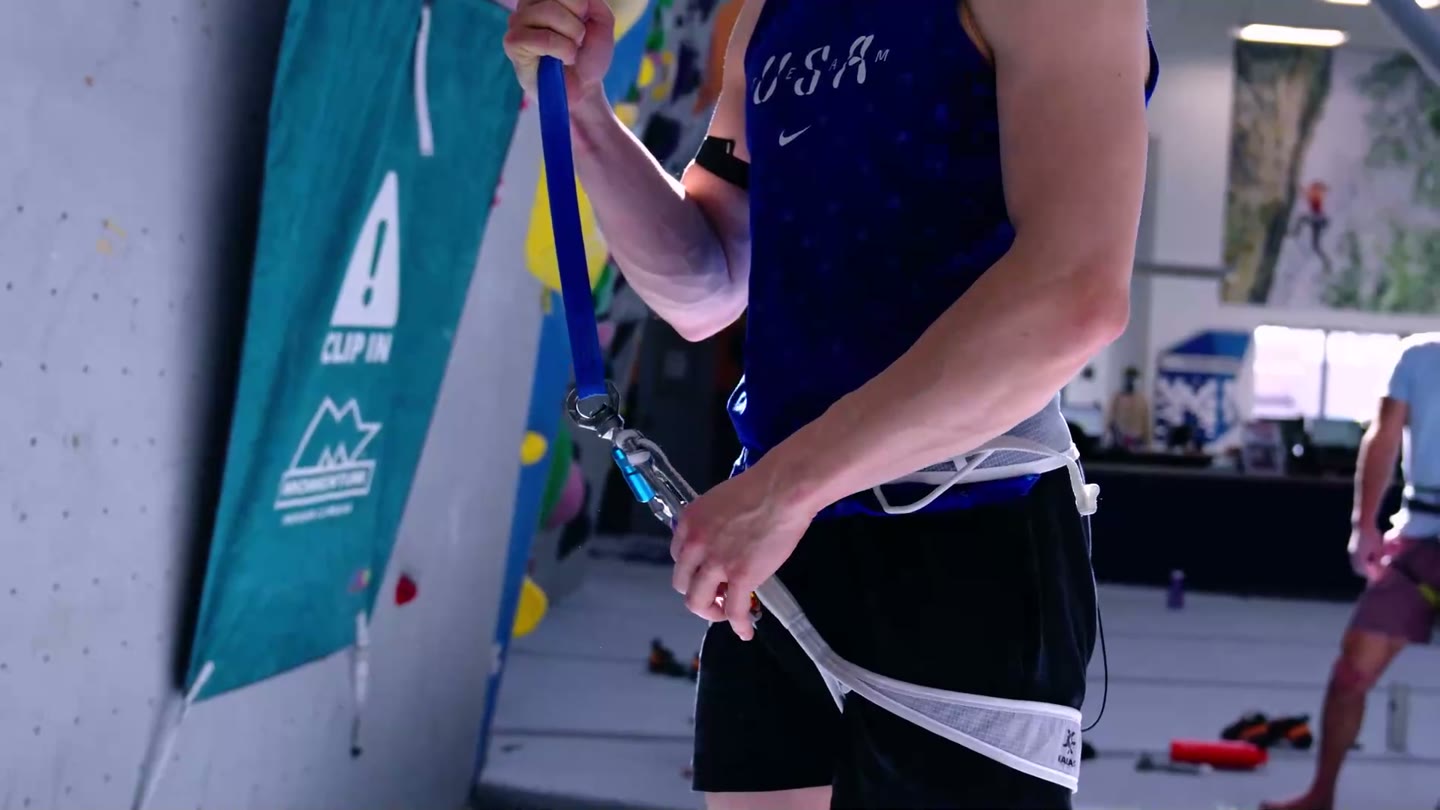
No, and this is one of the best reasons to start. Speed walls run on an auto belay, a self-retracting device that clips to your harness and catches you automatically when you let go at the top or come off mid-run.
That means no partner, no belay certification, no coordinating schedules with a climbing buddy. You clip in, you climb, the auto belay reels you back down, and you go again. Speed climbing for beginners is genuinely a solo-friendly sport, which makes it easy to squeeze training into whatever hour you have free.
What gear do you actually need?
Almost nothing. This is another reason how to get into speed climbing is simpler than most people expect.
- Climbing shoes, any pair will do to start. You do not need aggressive, downturned speed-specific shoes yet. Rentals are fine.
- A harness, most gyms rent these, and any standard harness works with the auto belay.
- Chalk, helpful for grip, optional at first.
That's the entire list. No rope, no belay device, no rack, no partner. Compared to nearly every other kind of climbing, the barrier to entry is remarkably low. Turn up, rent shoes and a harness, and you're ready.
How do I find a speed wall?
Standardized speed walls are more specialized than a bouldering cave, so a bit of hunting pays off. Not every gym has one, but they're spreading fast as the sport grows post-Olympics.
Start with the wall map. We map 100 speed walls across 35 countries, so you can find the certified 15-meter walls near you instead of calling around gyms hoping they have one. When you visit, ask staff whether the auto belays are set up for speed and whether they run any timed sessions or beginner intros.
If there's genuinely nothing nearby, a regular top-rope or lead wall can still build the strength and movement base you'll carry over later. But for real speed practice, you want the standardized holds.
Ready to find your closest wall and start training this week? Browse the wall directory and pick a gym.
What should my first speed climbing session look like?
Do not try to race on day one. Your first speed climbing session is about learning the route, not beating the clock. Speed comes from knowing exactly where every hand and foot goes, so muscle memory does the work while your brain stays calm.
Break the wall into sections
Nobody memorizes 31 holds in one go. Split the route into three or four chunks and learn them one at a time.
- Learn the start, the first few moves off the ground set your rhythm. Get comfortable clipping into the auto belay and launching cleanly.
- Work the middle, climb it slowly and deliberately, finding the sequence that feels natural for your body and reach.
- Find the finish, practice the top holds and the slap for the buzzer so the ending never surprises you.
Once each section feels smooth on its own, start linking them together. Climb the full route slowly, then a little faster, then faster still. The published sequence of holds, or the beta, is your map here. Dig into the beta to see how experienced climbers move through each part before you build your own version.
Prioritize clean over fast
For your first few sessions, a clean run beats a fast one every time. Slipping, missing a hold, or scrambling wrecks your consistency and teaches your body bad habits. Aim to complete the route without mistakes, and let the speed arrive on its own as the movements become automatic.
How do the first few sessions build up?
Expect the shape of your early progress to look like this:
- Session 1-2: Learn the auto belay, memorize the route in sections, climb it slowly and cleanly.
- Session 3-5: Link sections into full runs, smooth out the transitions, start timing yourself for a baseline.
- Session 6 and beyond: Chip away at your time, refine your start and footwork, and begin structured training off the wall to build the explosive power speed rewards.
Progress in speed climbing is unusually satisfying because it's measurable. You have a number, and you watch it drop. To put the ceiling in perspective: the men's world record is 4.54 seconds (Zhao Yicheng赵一程Zhào Yīchéng of China, May 2026), and the women's is 5.99 seconds, set by Emma Hunt of the USA in July 2026, the first woman ever under six seconds. You won't touch those numbers soon, and that's fine. Your only competition at the start is your last run.
How does a community speed up your progress?
You can learn the route alone, but you'll improve far faster with people who've already made the mistakes you're about to make. A good community shortcuts months of trial and error.
This is exactly why LearnSpeedClimbing exists. The site was founded by Olympic medalist Sam Watson and coach Albert Ok, and the whole point is to give beginners the direct feedback, training plans, and people-to-climb-with that turn slow first runs into real times. Someone watching your run can spot the wasted half-second in your start that you'd never notice on your own.
Join the community and share your first run. The LearnSpeedClimbing Skool community is where beginners post their session videos for feedback, follow structured training plans, and find other climbers at their local walls. It's the natural next step after your first session: instead of guessing what to fix, you'll have coaches and fellow racers helping you get faster, week after week. Come introduce yourself, tell us your baseline time, and let's take seconds off it together.
Getting into speed climbing? Learn with climbers chasing the same clock.
Join the Community →